Called ultraviolet electromagnetic radiation with a wavelength from 400 to 10 nm (frequency — 7,5-1014…3-1016 Гц) [1]. Весь спектр ультрафиолетового излучения по стандарту ISO-DIS-21348 [2] делят на четыре диапазона: ближний — 400…300 нм, средний — 300…200 нм, дальний — 200…122 нм и экстремальный — 121…10 нм. Излучение среднего диапазона практически на 90 %, а дальнего и экстремального диапазонов на все 100% поглощает земная атмосфера. Следовательно, воздействует на организм человека в основном излучение ближнего диапазона. При большой интенсивности это воздействие становится неблагоприятным и даже опасным. Поэтому её измерение весьма актуально. Согласно санитарным нормам [3], интенсивность ультрафиолетового излучения не должна превышать 5 мВт/см2.
Diagram of the device for measuring the intensity of UV radiation is depicted in Figure. 1. It uses a UV sensor ML8511 [4] with maximum sensitivity in the middle range. The output voltage of the sensor is directly proportional to the radiation intensity. In the absence of radiation it is equal to 1, while the intensity of 15mW/cm2 reaches of 2.75 V.
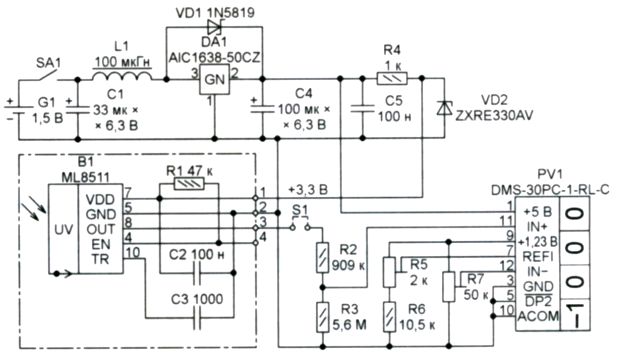
Figure. 1
Digital voltmeter PV1 measure output voltage of the sensor. It is pre-scaled using the voltage divider R2R3. The zero of the scale of the voltmeter and its sensitivity is set accordingly adjusted with resistors R7 and R5. Calculation of chains of scaling and correction of indications is detailed in the instructions for use IC digital voltmeter [5]. When proper adjustment of the zero of the intensity of the radiation on the display of the voltmeter should correspond to a value of 0.00, and a maximum intensity of 15 mW/cm2 — 15,00.
The meter is feed from a single galvanic element G1 AA. Current consumption — no more than 20 mA. Cell voltage increases to 5 V Converter on the chip DA1. Sensor supply voltage V1 of 3.3 V provides the Zener diode VD2 .
The tuning meter is not difficult. Collect technology the exemplary voltage divider of + 1 and +2,75 In the scheme shown on Figure. 2. Remove jumper S1 apply to the input of the divider R2R3 exemplary voltage of +1 V by Trimming resistor R7 set the voltmeter is equal to 0.00. Then apply the reference voltage of 2.75 V and a trimming resistor R5 set the scoreboard of 15.00.
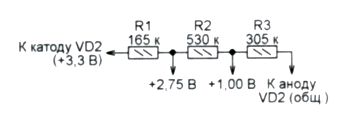
Fig. 2
Since the ML8511 sensor chip is very tiny and unsuitable for soldering in Amateur conditions, the device is applied to a ready-made module with this chip installed on the PCB size 16x16x3 mm (Fig. 3). It is slightly more expensive than most chips, but to work with him much easier. Details of the module in Fig. 1 enclosed in a dotted frame.

Fig. 3
Микросхема цифрового вольтметра DMS-30PC-1-RL-C имеет номинальный интервал измеряемого напряжения -1,999…+1,999 В, о чём свидетельствует индекс 1 в её обозначении, красный цвет отображаемых на табло цифр (индекс R) и потребляемый ток не более 17 мА (индекс L). Резисторы R2 и R3 должны быть с допуском не хуже ±0,5 или ±1 %. Подстроенные резисторы R5 и R7 лучше применить многооборотные. Печатная плата измерителя показана на Figure. 4.
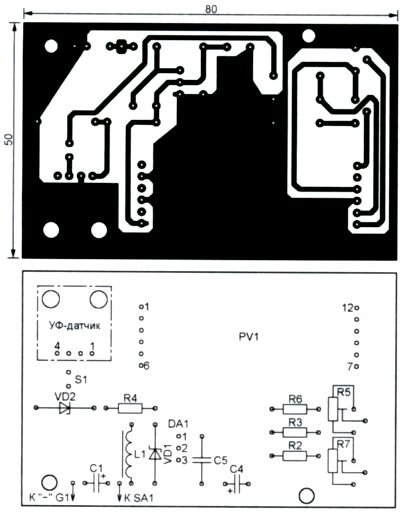
Fig. 4
In conclusion, I want to note that the described device can be successfully used to test the degree of absorption of ultraviolet radiation by sunglasses. First, measure the intensity of radiation when open sensor, and then close it lens glasses. The difference in the readings and will show the effectiveness provide points of protection.
LITERATURE
- Ryabtsev A. N. The ultraviolet radiation. //Physical encyclopedia. — M.: Great Russian encyclopedia, 1998, vol. 5, p. 221.
- International Standard ISO Space environment (natural and artificial). Process for determining solar irradiances. — URL: http://www.spacewx.com/Docs/ISO_21348-2007.pdf (18.09.15).
- Sanitary norms of ultraviolet radiation in the premises (app. Chief state sanitary doctor of the USSR on 23 February 1988 No. 4557-88). — URL: http://www.normload.ru/SNiP/Data1/47/47650/index.htm (18.09.15).
- ML8511-00FC. Reference Board Manual for UV Sensor (QFN). — URL: http://media.digikey.com/pdfData Sheets/Rohm%2OPDFsML8511-OOFCRefBrdManual-01.pdf (18.09.15).
- DMS Application Note 12. Signals with Zero Offsets. — URL: http://www.datelmeters.com/data/meters/dms-an12.pdf (18.09.15).
Author: A. KORNEV, Odessa, Ukraine
