To provide better video quality with limited bandwidth television tract used algorithms of digital video compression. Currently, changing standards МРЕG-2 and МРЕG-4 part 2 came standard N. 264 quite new but very promising standard N. 265.
Both standard N. 264 and N.265 provide a significant reduction in the size of the video file (from 25 to 50%) while maintaining the same quality in the old video standards. Consider how this is achieved.
Standard MREG-4 cardiovasculart 2 and Standard .264 N / AInFROM
МРЕG-4 (13О/IЕС 14496) – это совокупность стандартов для кодирования цифровых видео- и аудиосигналов. Эти стандарты описывают стандарты сжатия видео- и аудиоданных, а также содержат информацию системного уровня, которая описывает свойства файлов формата МРЕG-4.
In practice, the most frequently used popular standard compression МРЕG-4 рагt 2 (ISO/IEC 14496-2). Block diagram of coder МРЕG-4 shows in Fig.1.
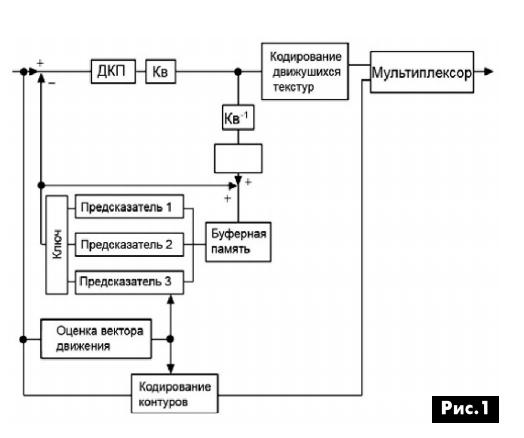
The video compression standard H.264 was added in MPEG-4 as bogstandard the МРЕG-4 part 10 (15O/IEC 14496-10). Ie currently standard MPEG-4 contains two bogstandard video compression, called рагt 12 and part 10. These two video compression standard are incompatible, as each of them uses not only the various compression techniques, but various forms of representation of the compressed video data. Thus, the decoder МРЕG-4 part 10 (H.264) can decode the digital stream МРЕG-4 part. 2, and Vice versa.
Standards codecs H.26X
H.264 standard and N.265 represent a further evolution of the line H.26X codecs (Fig.2), which are widely used in different applications: from videoconferencing to the Internet and broadband communication networks to digital TV and CCTV, including wireless IP networks. Over the past 10 years among developers of applications and services has become a very popular video codec H.264/ АVС (Advanced Video Coding) and its scalable version of the SVC.
 Standard N. 264
Н.264/АVС – это международный стандарт видеокодека (кодера и декодера), который предназначен для сжатия и распаковки цифрового видео с целью уменьшения полосы пропускания, требуемой для передачи и хранения видео. Он был предложен группой экспертов JVТ (Joint Video Team) в мае 2003 г.
Как известно, стандартный цифровой видеопоток DVD качества ССIR601 в несжатом виде при разрешении 720×480 пикселей 4:2:2 (см. врезку цветовое пространство YCbCr) видео и 30 кадр/с составляет 158 Мбит/с. Это значительно превышает возможности Интернет-сетей передачи данных и приводит к тому, что один часовой файл такого видео занимает объем около 79 Гб.
Конечно, можно уменьшить скорость видеопотока, сведя его к разрешению, например, стандартных камер для видеонаблюдения типа SIF, т.е. до 352×240 пикселей 4:2:0 видео 30 кадр/с. При этом битрейт уменьшится примерно в 10 раз. Однако для работы мобильных устройств и достижения того, чтобы 1,5-часовой видеофильм занимал около 0,4 Гб, требуется сжатие исходного видеопотока примерно в 300 раз. Как раз это и обеспечивает видеокодек Н.264.
The successful consolidation of the market standard N. 264/АVС contributed to the low license fees for its use from the МРЕG.-LA by the year 2010, the number of videopredatory on the basis of N. 264/АVС surpassed the number of sentences in the standard МРЕG-2. This trend has continued to the present time, despite the emergence of a new compression standard H.265/ НЕVС.
Standard N. 264/АVС at a bitrate of 1.5 Mbit/s allowed to receive standard-definition video broadcast quality. I.e. there is the possibility to transmit up to 12 compressed TV channels in the bandwidth previously required to transmit just one analog channel. This allowed broadcasters to provide new services for video, and dramatically increase the number of broadcast television channels.
It is the implementation of the standard N. 264/АVС allowed to start a new stage in the development of Internet TV, mobile TV and made widely available high-definition television НDТV. Codec N. 264/АVС filed IТU), is now used in 80% of videos posted on the Internet.
Key features of the standard .264 N / AVS
In the standard N. 264/AVC uses advanced encoding technology video on techniques similar to the encoding technology in previous standards: МРЕG and ITU-T In order to provide a smaller bitrate while maintaining high image quality using new tools.
|
Optimizing encoding settings
The disadvantage of classical coding is making locally optimal decisions at each stage of video processing. In the end, the total solution will not be optimal. IN N. 264/AVC algorithm is used for optimize the parameters of encoding РDО (Rate distortion optimization). In the encoding process are selected such parameters, which provide the best result.
Improved motion estimation
Для поисков субмакроблоков различных размеров, от 16×16 до 4×4 пикселей, используется оценка движения. При этом точность определения вектора движения увеличена, как для сигналов цветности, так и для сигнала яркости. Для улучшения кодирования векторов движения используется их предсказание.
Improved coding when smooth motion
One important difference from the standard N. 264/AVC from its predecessors is the introduction of a new set of conditions for coding the macroblock in the skip mode. In the end, the macroblock is not encoded, but instead uses a different macroblock in the same position, but from a different frame, which can significantly reduce the bitrate. With particularly large gains in the reduction of the video stream is achieved at low bitrates, or when the whole image moves the same way, for example, the smooth movements of the camera.
Filtering block boundaries
The difference between the standard N. 264/AVC from the previous ones is the use of a deblocking filter. This filter smooths out the blocky artifacts at the boundaries of macroblocks in the picture. This leads to improved visual perception of each frame and the entire video as a whole.
Spatial prediction
Depending on the direction of movement.264/AVC uses up to 9 different ways of spatial intra prediction for intra-coded blocks.
Modified Discrete Cosine Transform
Для предотвращения ошибок округления при преобразовании остаточной информации используется модифицированное целое дискретное косинусное преобразование (МДКП). При этом в отличие от других стандартов сжатия видеоинформации, размеры блока для МДКП существенно уменьшены, до размеров 8×8 или 4×4 пикселей.
Entropy Coding
In the standard N. 264/AVC used in more productive processes of entropy encoding.
- Contex-adaptive binary arithmetic coding (САВАС) – контекстно-адаптированное двоичное
арифметическое кодирование, которое представляет собой арифметический кодер. Это кодирование позволяет добиться практически максимально возможной эффективности сжатия. Но этот тип кодирования требует существенно больше ресурсов, чем другой тип кодирования – CAVLC. - Contex-adaptive variable length coding (CABAC) – контекстно-адаптированное кодирование с различной длиной кодового слова. Этот кодер, основанный на алгоритме сжатия Хаффмана,
allows to speed up the process compression of information, but unlike SAVAS does not provide the maximum possible efficiency of its compression.
All this led to the fact that the magnitude of the bitrate when using the standard N. 264 is considerably less than the МРЕG-4 рагt 2 and other of his predecessors. This is evident when in the frame there is no movement (Figure 3).,ru
 Standard and its implementation
It is important to understand the difference between the standard and its implementation. It is a different concept. Often say: "N. 264/AVC provides better video quality than the МРЕG-2". This is not true, as N. 264/AVC is a video compression standard, not a standard that determines its quality for any particular purpose.
Стандарт Н.264/AVC defines the structure produced by their digital stream, and this stream must exactly match the decoder that implements the tools specified by the standard to decode the digital stream.
H.264 Encoder can only implement structure defined by a standard, while ensuring the creation of a corresponding digital stream. It is important that various types of implementations and algorithms of the encoder are not defined by the standard, but are created by the developer.
Thus, the N coders.264 different companies-producers will create a variety of Poteauki video at the same speed netransmission of the data.
To speak correctly: "the Standard N. 264 gives you more choice of the structure of the video and tools than the МРЕG-2, and gives the opportunity to create a better video encoder. Ie, this video encoder can create more quality videos at the same data rate and same video quality as the МРЕG-2 at a lower speed of data transmission".
In the table demonstrated the result of encoding the same sequence using different reference tools encoder N.264 ЈМ11), available for free in the International organization for standardization (ISO). Each digital stream obtained as the result of each test, fully complies with the digital streams of standard, N.264/A/C and has identical video quality.
From Table it is clearly seen that the greater the number of tools and algorithms, the greater the degree of compression for the same quality video. However, a high degree of compression complicates the encoding process and increases its duration. It is the increasing difficulty of coding is the reason that some of the tools or algorithms in the configuration N. 264 encoder is often not used.
|
Realization algorithm |
The size of the stream information, kB / s |
Total Time Coding (relative) |
|
|
Encoding only I-frames |
2279 |
1 |
|
|
I and P-frames but with no motion estimation (0 search range) |
1055 |
1,5 |
|
|
I and P-frames with ± 16 search using a simplified search algorithm |
453 |
1,4 |
|
|
I and P pictures using the full search algorithm with motion compensation |
421 |
56 |
|
Advantages of the H.264 standard
Consider a video encoder, in which video frames are captured from the video camera and sent to the internal H. 264 encoder to compress. Each video frame is compressed in one of two ways: as I-frame P-frame.
I-frame is a video frame that was encoded without reference to any other video frame. Video stream or the entry always begins with the I-frame, and usually contain such I-frames throughout the stream. These regular I-frames, also called intra-frames (instra frames)the main frames (key frames) or APs (accesspoints) are key for random access to information recorded by the encoder of H. 264 files, for example, when rewinding or search during playback. The regularity of these I-frames is called "the interval of I-frames". The drawback of using I-frames is that they occupy a much greater volume than P-frames.
P-frames are frames with compensation for the shift, in other words, the encoder uses the difference between the currently processing frame and previous video frame, verifying that the information on it has not changed and thus, for example, a static background is not transmitted continuously. Unlike coders, based solely on differences in neighboring frames, such as Delta-MJPEG, encoder H/264 not only looking for differences, but also the ongoing videovista. This is because coders with motion compensation, provide a smaller bitrate than mere coders based only on finding differences. The process of finding the motion known as "motion prediction".
Assessing movement is one of the most expensive computationally and the most important parts for the operation of the encoder H. 254. The prediction of movement is a complex procedure and often encoders, especially software working in real time, use the reduced area of the search or the limited search algorithm or limited search algorithm of the movement to ensure work in real time. Often this can lead to low video quality and significant reduction in compression ratio. Have hardware H. 264 encoder such there is no shortage.
Compared to MPEG-4 part 2 H. 624 can provide savings of digital traffic flow between 20% to 25% under normal conditions and over 50% in the period, when in the frame there is no movement (Fig.3.). This not only reduces the General requirements to the bandwidth for video, but more importantly, can greatly reduce the amount of storage needed to record video, which is often one of the most time consuming elements of the system. The block diagram is shown in H.264 encoder Figure 4.

Hardware Requirements
It follows that in the H. 264 standard requirements for processing capacity of the encoder is significant, if you use the full range of its properties and implement all its advantages. Note that the H. 264 standard is a video compression standard for General purpose, which is not developed directly which was not designed specifically for CCTV applications. However, when using specially designed based on chip field programmable gate arrays (FPGAS FPGA or English) can be provided with the necessary speed of video processing, and such development can be adapted to CCTV applications. For example, additional compression of the image specified in the H. 264 standard, can be achieved at low activity video, i.e. in a situation typical for many applications of video surveillance.
The use of specialized hardware encoders on the basis of the FPGA has several advantages:
- High quality video can be produced with fast motion in the camera field of view with no frame loss, regardless of transmission speed and traffic. This is a critical requirement for such applications, for example, as a system of surveillance at the casino;
- Low cost and high performance video encoding with resolution up to 4SIF(i.e. 4·[352×288] pixels) at 30 frames/s, which is fully consistent with the H. 264 standard;
- The ability to update already installed systems for the use of new compression standards;
- Real-time Analytics that can work on high-performance hardware faster than using this software.
A significant gain in file size provided by the H. 264 codec in comparison with others, with the same peak signal-to-noise ratio (PSNR) is clearly visible on Fig.5.
Coding standard H.265 / HEVC
In 2013. The international telecommunication Union (ITU) adopted compression standard H. 265/HEVC(HighEfficiencyVideoCording, i.e. high-efficiency video coding), which will allow you to transfer video with half the bitrate than H. 264, while maintaining the quality of images. This codec supports video resolutions up to 7680×4320 pixels, preview 4k video encoded in H. 265 Stangate enough Internet connection with a speed of about 25MB/s.

| Standards cameras SIF or CIFCIF(with encoder H. 261/H. 263) and SIF(with encoder MPEG-4) are the designations of the video resolution. The mean CIF resolution 352×288 pixels, regardless of the video system incoming video signal, NTSC or PAL.The resolution defines the SIF 352×288пикселей camera with PAL system and the resolution is 352×240 for NTSC system camera. Found a resolution of 352×240, also being a valid resolution SIF. Unfortunately, because of phonetic similarities and identichnosti sources PAL these terms are sometimes used runasdate, though they differ. Ie, sometimes, when they say CIF, in fact, refers to the SIF.
So, if your system – CIF (2 CIF or 4 CIF), you are using an old encoder based on H. 261/H. 263, and the system would not be compatible with MPEG-4 part 2 or H. 264 based on SIF. So if there is a need for a valid MPEG-4 part 2 or H. 264, then choose SIF. |
The main goals pursued in the development of new video codecs, in particular H. 265 will remain unchanged, although they are contradictory:
- The low bit rate, i.e. increasing the degree of compression of the digitized video stream while maintaining the quality of its decoded version (due to more complex signal processing);
- Reduced latency for applications that operate in real-time (security systems, video chats, video conferencing, etc.);
- The reduction in hardware resources required for processing video data;
- The increase in ustochivost to the signal loss in the transmission of multimedia information.
In addition to the attempts to achieve these goals in the standard H. 265/HEVC is used to work with high resolution HD, i.e. 4k x 2k (3840×2160) 8kx 4k (7680×4320) pixels, applied architecture and parallel processing.
H.265/HEVC-based approach, which seeks to reduce redundancy of the image by:
- Reducing the redundancy in neighboring frames (inter-coding), by assessing motion and its compensation.
- Reduce spatial redundancy in the reference or differential frames due to intra-coding. The same approach is used in the H. 264 codec, however, the standard H. 265/HEVC provides more extensive adaptation of the parameters of the codec and extended the range of their variation.
When this is used:
- Variable size of macroblocks of the image;
- Macroblocks of the image, which have a tree structure;
- Deblocking filter operates in parallel processing mode;
- The filter in the feedback loop (Fig.6.)

To improve the quality of rendering is used to downsample the color (chromatic) component 4:2:2 and 4:4:4 (in addition to 4:2:0).
Inherent in the standard hierarchy, which includes profiles, layers and levels. In the future they can be expanded depending on the video codec, for example, when the alleged development of its scalable version of the SVC.
The standard also paid attention to possibilities for a flexible presentation of videos of various resolutions. For this purpose:
- The coding unit (CU)
- The prediction unit(PU)
- Unit conversion(TU)
CU is the basic unit of video compression. Its structure is the same as that of the macroblock in MPEG-2, but it is made much more flexible. For efficient compression of HD and 4k video in standard H. 265/HEVC supported CU sizes greater than 16×16 ( as in the H. 264 standard), for example, 32×32 and 64×64.
PU is a prediction unit, and one unit CU may contain multiple PU. Asymmetrical split into sections of the movement (AMP) is used for efficient encoding of irregular patterns of the video frame.
TU is a unit, as the unit CU may include one or more PU. In addition to the standard transformation of 4×4 and 8×8 TU also supports fast conversion of 16×16 and 32×32.
In the standard H. 265/HEVCтакже improved prediction of motion vectors and modified 1/4 –pixel interpolation filters.
Special attention is paid to the reduction of distortion between the original and reconstructed video frames, which combined multiple filters decoder H. 265. To reduce the secondary distortion of local areas in addition to a modified deblocare filter introduced adaptive filter, SAO (Sample Adaptive Offset).
A novelty, compared to H. 264/AVC, H. 265/HEVCстало the introduction of the new notion tayl (tile). The tiles divide the frame into a grid of rectangular regions that can be encoded and decoded independently from each other. Unlike slice (slices) the tiles are not separate units of syntactic encoding, thereby achieving a further increase in the compression ratio. The use of tiles allows you to increase the performance of encoding and decoding video data due to the simultaneous holding of these processes on modern multi-core desktop or mobile platforms.
Standard H. 265/HEVC on average achieve about 40% reduction in the size of the encoded video compared with H. 264/AVC (720p.), 50% – to allow 1080i, R and more than 50% for 4k. On Figure 7 shows the sizes of the video and MV when using compression, Q = 24, 30, and 40 obtained by the encoders H. 264 and H. 265. As can be seen, the encoded video file to H. 265 is obtained at 1.7-2 times less.
Velicina bitrate, which is required for obtaining the same search in signal-to-noise ratio (PSNR) for different values of the PSNR at HD resolution of 1920×1080 pixels and 24 frames/s is shown in Fig.8.
Ozhidetsya that H. 265 will come into use in the next few years. Products supporting the new standard has already been introduced Ericsson, Mitsubishi, Qualcomm and other companies.
Author: Andrey Semenov, Kiev
Radioamator №3-4, 2014
